You cleaned yesterday.
Like, actually cleaned. Not just shoved stuff into a drawer and called it a day. You wiped things down. You put things away. You maybe even vacuumed, which — let’s be honest — deserves its own gold star and possibly a small trophy.
And yet somehow, you woke up this morning, walked into your kitchen, and thought: what happened.
The counter has three new items on it that definitely weren’t there last night. There’s a cup in the sink. The throw blanket is on the floor for reasons no one can explain. Someone has left a single sock in the middle of the hallway, and it is not yours.
Here’s what’s maddening: you’re not lazy. You’re not ignoring it. You’re cleaning constantly and your house still looks like a Pinterest fail.
So what gives?

The Real Reason Your Home Never Feels Clean (Hint: It’s Not You)
Most cleaning advice is written for people who already have everything under control.
It assumes your home is in some calm, steady state and you just need to maintain it. Morning routine! Weekly reset! Wipe the counters every night before bed!
Great tips. Adorable. Totally useless when you’re three days behind, the laundry has formed its own civilization, and you have forty-five minutes before someone comes over.
That advice doesn’t help you recover. It only helps you coast.
And if you’re a mom — or honestly just a person with a life — coasting is not your default setting. Surviving is. Managing. Pivoting. Eating lunch standing over the sink because sitting down felt like too much of a commitment.
Your home isn’t dirty because you’re failing at the system.
You’re failing at the system because the system wasn’t built for your actual life.
Why Cleaning More Isn’t the Answer
When things start spiraling, the instinct is to do more. Clean longer. Do a big weekend reset. Tackle everything at once and finally, finally, get back on top of it.
So you do. And for about twenty minutes, it’s glorious. Everything has a place. The surfaces are clear. You feel like a person who has it together. You maybe even light a candle.
Then Tuesday happens.
And you’re right back where you started, except now you’re also exhausted and vaguely resentful of your own house.
The problem isn’t your effort. It’s that you’re trying to finish something that doesn’t stay finished.
Laundry comes back. Dishes come back. Clutter appears on surfaces like it’s being generated overnight by tiny invisible gremlins (possibly named after your children). This is just how a home works. Especially one with actual humans living in it.
Trying to get it “done” is like trying to win a war against Tuesday. It keeps coming.
Here’s the thing nobody tells you: the goal was never to finish. The goal is to build something you can actually come back to.
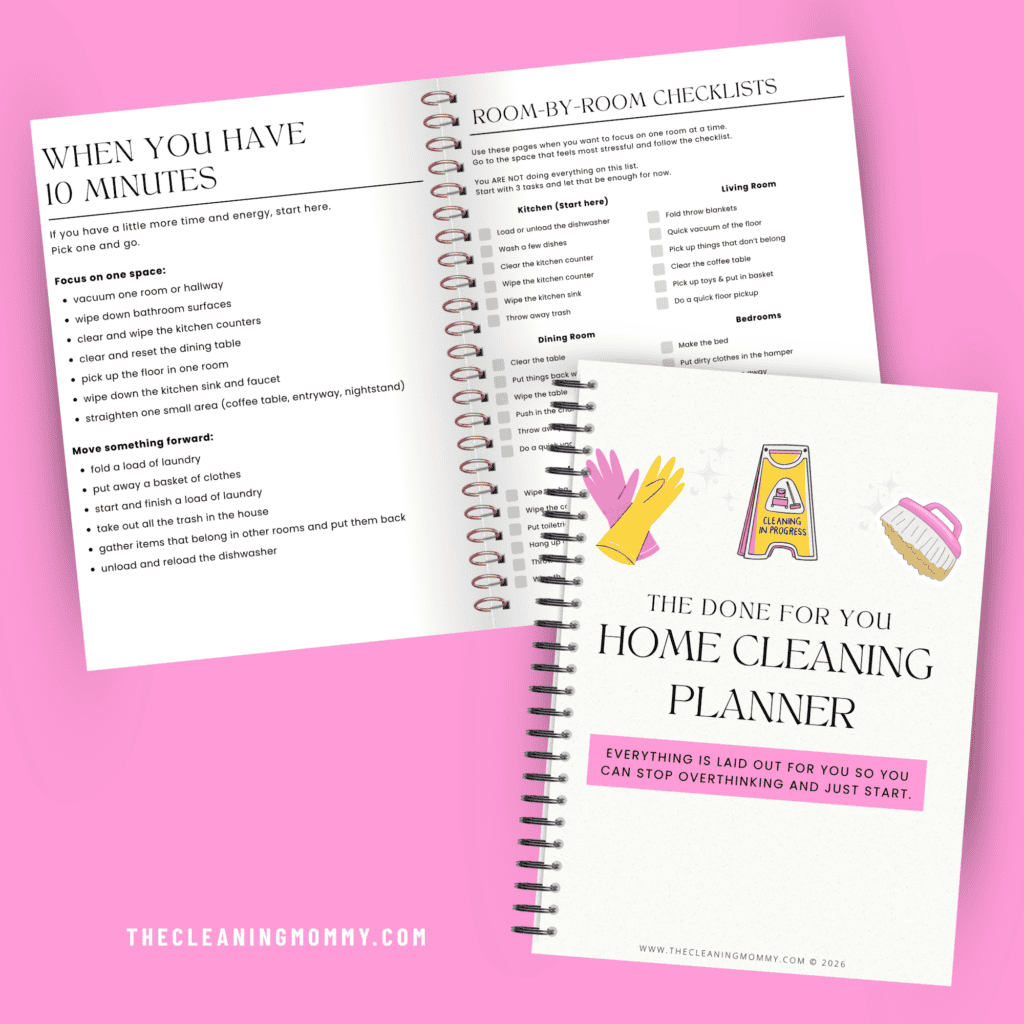
If you need help figuring out where to start cleaning, you need my Done For You Cleaning Planner that tells you exactly what to clean
The “Getting It All Done” Trap
There’s this idea most of us have absorbed — probably from someone whose kids were grown and whose house had very few humans actively destroying it — that the right approach is to power through until everything is clean. All of it. At the same time.
And then you’ll be in control.
But that finish line keeps moving. You clean the kitchen and someone makes a snack. You fold the laundry and it sits on the couch for four days because no one puts it away, including you. You sweep the floor and there’s sand on it again by dinner because somebody was outside doing something you didn’t even know about.
It’s not chaos. It’s just a house.
But when your system is built around finishing, you spend all your energy trying to reach a state that resets itself every single day. And then you feel like you’re failing when really, you’re just running on a hamster wheel that was designed wrong from the start.
What Actually Works (And Why It Feels Almost Too Simple)
You stop trying to clean everything and start thinking in small resets.
One space at a time. Not the whole house. Not “I have to get it all done before I can relax.” Just — what’s the one spot that’s making everything feel worse right now?
Start there. Make it functional. Stop before you’re completely wiped out.
That’s it.
It sounds almost insultingly simple. But the reason it works is because you’re not waiting for a perfect plan or a free Saturday or the motivation to strike like lightning. You’re just doing the next small thing, and then you’re done.
And “done” feels good. Even if it’s just a clear counter or a made bed or a living room you can walk through without stepping on something.
The other thing that changes? You stop dreading it.
When cleaning means “I have to do everything right now,” you avoid starting because starting means committing to a project you don’t have energy for. But when it means “I’m going to spend ten minutes on the kitchen and then I’m done” — that you can do. Even on a bad day. Even when you’re tired. Even when you’ve already said you’d do it three times and you still haven’t.

The Real Goal Isn’t a Clean House. It’s a House You Can Reset.
Here’s the reframe that actually matters.
You don’t need your home to be perfect. You need to know what to do when it isn’t.
That’s the gap most cleaning systems never address. They tell you what to do when everything’s fine. But what about when it’s not? What about the week where the schedule falls apart and you get sick and the kids are home and somehow the pantry has exploded?
You need a system that works on those days too.
Not one that requires perfect consistency to function. Not one that collapses the moment you miss a day (or a week, no judgment). One that gives you a clear starting point when you’re overwhelmed, so you don’t spend twenty minutes just deciding what to even do first.
Because that paralysis — standing in the middle of the mess and not knowing where to begin — is its own kind of exhausting. And it’s fixable.
Why This Matters More Than Just The Mess
When your home feels out of control, it doesn’t stay in the house. It follows you around.
It’s the low hum of stress you can’t quite name. The thing you’re half-thinking about at dinner. The reason you feel vaguely worse than you should when you walk through the door after a long day.
It affects your energy. Your patience. Whether you feel like you’re keeping it together or constantly dropping balls.
That’s why solving this isn’t really about cleaning. It’s about not carrying that background noise everywhere you go.
And that only happens when you have a system that fits your real life — not the version of your life where you have unlimited time, unlimited energy, and children who put things back where they found them.
Where to Start If You’re In the Middle of It Right Now
If your house always feels messy no matter what you do, here’s the question worth asking:
Not “How do I clean more?”
But “What helps me when I’m already behind?”
Because that moment — the one where you’re tired and behind and you don’t know where to begin — is the one that keeps repeating. And most systems skip right past it. They assume you’re starting from calm and organized, not from a pile of laundry and a sink full of dishes and the vague guilt of three days of not dealing with any of it.
Start with one room. Or one surface. Set a timer for ten minutes and don’t try to do everything — just do something. The momentum that comes from finishing even one small thing is real, and it makes the next thing easier to start.
You don’t need to overhaul your whole approach today.
You just need a way to move forward from exactly where you are.

You just need a way to move forward from exactly where you are.
Not a perfect plan. Not a free weekend. Not a version of yourself who has more energy or more hours or more patience than you actually have right now.
Just a starting point. A system that meets you in the mess instead of assuming you’ve already cleaned it up.
That’s exactly what the Done For You Planner is built around.
It’s not another routine that only works when your life is cooperating. It tells you exactly what to do when you are completely overwhelmed! It works well for those real days — the busy ones, the low-energy ones, the ones where you blink and somehow it’s 4pm and nothing has been done and someone needs dinner.
It gives you a clear starting point when you’re overwhelmed. It tells you what to do first when your brain is too fried to figure it out. And it’s designed to work in small chunks, so you’re not waiting for a stretch of free time that may never actually come.
The goal isn’t perfection. It never was.
It’s knowing that when things fall apart — and they will, because that’s just Tuesday — you have something to come back to. Something that works. Something that doesn’t require you to start all over from scratch every single time.
That’s the shift. Not trying harder. Not doing more.
Just finally having a system that fits the life you’re actually living.
Check out The Done For You Cleaning Planner here
You’ve got this Mama
Other Cleaning Articles You May Like:
- How To Clean Toilet Jets The Easy Way
- How To Remove Black Mold From Shower Caulk
- How To Remove Rust Stains From Porcelain Bathtub
- How To Clean a Bathroom Sink Overflow Hole
- Best way to clean kitchen tiles
- 3 of my best methods to make your own diy eyeglass cleaner


Leave a Reply